ChatGPT Enterprise vs. Custom AI for SharePoint: A Head-to-Head Test
Published:
Give me the TL;DR of this article with:
 ChatGPT
 Claude
 Perplexity
 Google AI
 Grok
GrokMany organizations rely on SharePoint as their central knowledge hub, but finding specific information can be a major challenge. Standard search is often a blunt instrument, returning documents instead of direct answers. The promise of AI is to fix this, but the question is which approach works best: a general-purpose tool like ChatGPT's Enterprise plan or a custom-built internal solution?
You can watch our full comparison here: https://youtu.be/n5pLpk0y_aU
The Problem with General-Purpose AI in a Specialized Environment
We wanted to see how well ChatGPT Enterprise, with its new SharePoint integration, could handle the kind of complex, varied data that knowledge-intensive teams use every day. To do this, we didn't just theorize. We built a custom internal chatbot hosted on a private Azure instance and ran a direct, seven-part experiment against ChatGPT Enterprise. We tested both systems on their ability to extract information from PDFs, complex Excel tables, PowerPoint presentations, technical drawings, scanned documents, images, and even internal video files stored in our SharePoint.
The Logic of the Experiment
Our goal was to test for precision and capability, not just conversational ability. We weren't interested in a tool that could chat; we needed one that could find specific, verifiable data points buried in non-standard file types.
- Standard Documents (PDFs, PPTX, Excels): Both systems performed reasonably well with clean, text-based files. This was the baseline.
- The Technical Drawing Failure: The first major gap appeared with technical drawings (blueprints). ChatGPT Enterprise failed completely. It couldn't read the specific text or dimensions from the drawings, rendering it useless for this critical file type. Our custom model, however, was able to extract the necessary information.
- Scanned and Visual Data: When it came to messy, scanned documents and images, the performance differences became more apparent. A custom solution allows for fine-tuning the logic to handle lower-quality inputs, which is a common reality in many organizations.
- Searching Inside Video: One of the most significant tests was searching video content. We built our system with the logic to index and search the spoken words within video files. This allowed us to ask a question like, "At what point in the video did we discuss the Azure pricing model?" and get a direct timestamp. ChatGPT Enterprise does not have this capability for internal video files.
The Outcome: Control, Security, and Cost
The experiments revealed a clear trade-off. While ChatGPT Enterprise offers a quick setup, it lacks the specialized capabilities required for many professional environments. More importantly, it introduces significant security and data privacy concerns. When you connect a third-party service to your SharePoint, your internal data is processed on external servers, creating risks of data leakage and compliance violations.
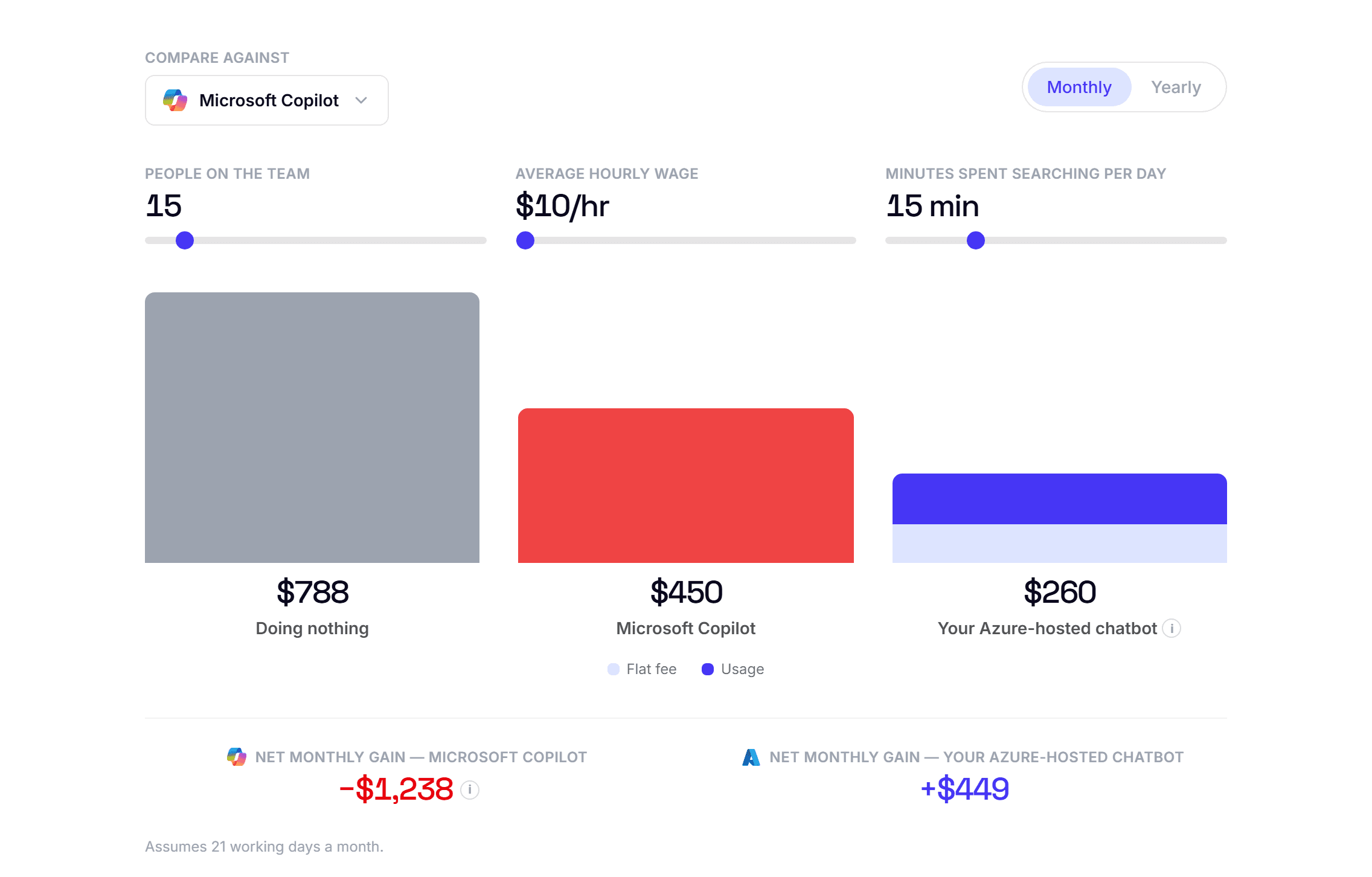
Our custom chatbot, hosted on a private Microsoft Azure instance, keeps all data within our own secure environment. This single-tenant approach provides complete control over the data and the AI's logic. The system is now live. It handles queries across all seven file types, and our team no longer has to manually scrub through videos or guess which technical drawing contains the right specification. From a cost perspective, the Azure hosting model proved to be more predictable and scalable than the per-user pricing of ChatGPT Enterprise, especially for larger teams.