The Blueprint for an Internal Chatbot That Gives Perfect Answers
Published:
Give me the TL;DR of this article with:
 ChatGPT
 Claude
 Perplexity
 Google AI
 Grok
GrokAn AI is only as good as the data you feed it. We see this constantly. Teams invest in building an internal knowledge base, expecting instant, precise answers, only to find the system gives vague responses or misses the mark entirely. The problem isn't the AI model; it's the data structure. If your files are a mess, your AI's answers will be a mess.
You can watch the full walkthrough of our internal blueprint here: https://youtu.be/vyrLTVuTbK8
This isn't a theoretical issue. It's the difference between an AI that finds a specific technical diagram in seconds and one that tells you it can't locate the file. The core problem is that most company file systems on SharePoint or OneDrive were organized for humans, not for machine readability. An AI can't guess that 'Project_Update_Final_v2_John.docx' contains critical engineering specs from last March.
Preparing Data for AI Ingestion
To solve this, we don't use a more powerful AI model. We built a systematic approach to data preparation. We established a set of strict, logical rules for how to name and format files before they ever enter the AI's knowledge base. The logic is to make unstructured data structured at the source.
We chose this approach because an AI doesn't 'see' a file the way a human does. It reads metadata, text content, and structural cues. By optimizing these elements, we guide the AI to the correct information packet every single time.
Handling Video and Image Files
For video files, which are often black boxes of information, our system focuses on three data points: the voiceover, the subtitles, and the video description. The AI ingests all three, making the entire spoken content of a video searchable. We also enforce a clear naming convention and require all videos to be in MP4 format, as older formats like AVI or MOV can fail during the data ingestion process.
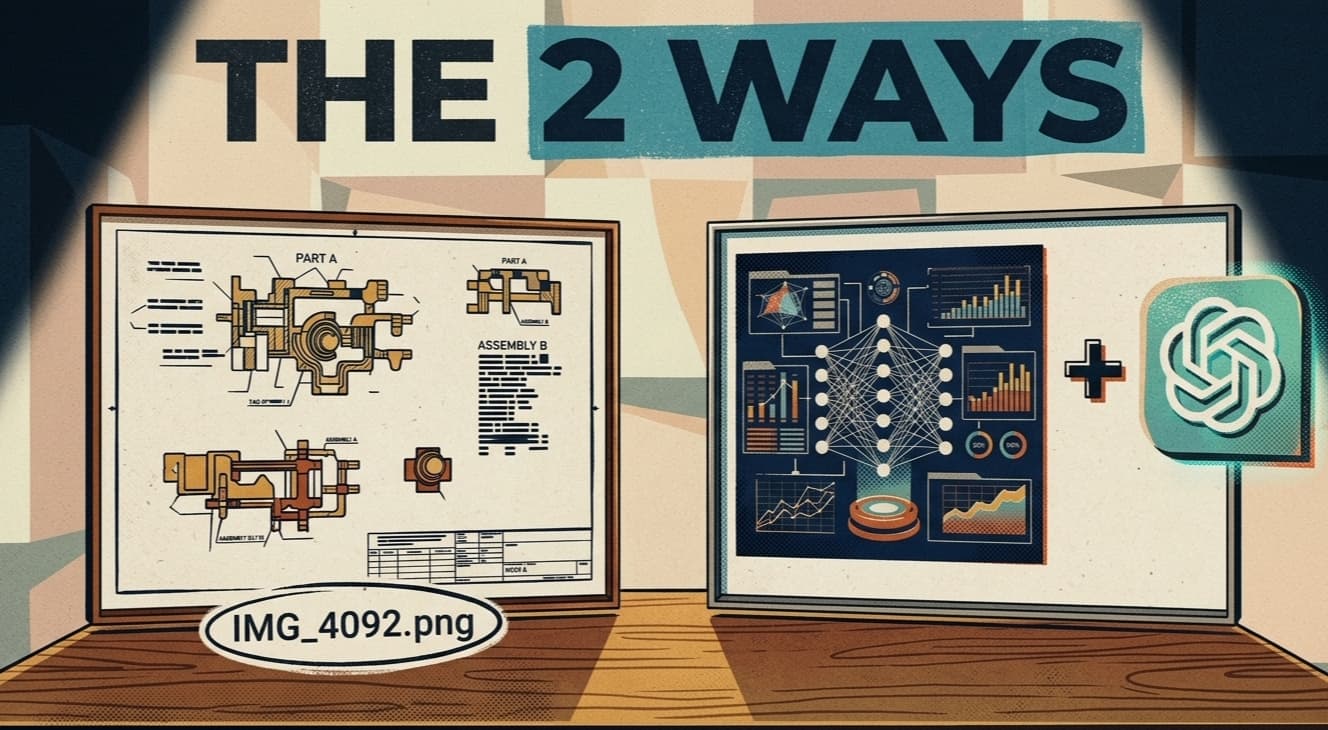
Images present a similar challenge. A file named 'IMG_4071.jpeg' has no context. Our rule is simple: name the image exactly how a team member would search for it. For example, '2024-q1-server-rack-diagram-main-office.png'. This turns a non-searchable asset into a findable one.
The Rules for Documents and Scans
Documents are the backbone of most knowledge bases. We found that simple changes have a massive impact.
- No ZIP Files: Compressed folders are invisible to the AI. All files must be extracted before they can be indexed.
- Convert to PDF: While
.docxfiles work, converting them to PDF preserves formatting and structure more reliably. We recommend using tools that can automate this conversion process. - Table of Contents (TOC) is Critical: For long PDFs, a well-structured TOC with clear headers is the single most important factor. The AI uses these headers as signposts to navigate the document and pull precise answers from specific sections.
One of the most common questions we get is about scanned documents. Our system can handle them. The AI performs optical character recognition (OCR) to read the text from scans, making them just as searchable as a native digital document. The same logic applies to technical drawings; they must be in a vector format like PDF, not flat JPEGs or PNGs, to ensure the text within them is readable.
Key Takeaway The quality of an AI's answers is not determined by the AI model itself, but by the structure and cleanliness of the source data. Enforcing strict naming conventions and file formats is the most effective way to build a high-performing internal knowledge base.
The Outcome
Here is the pdf manual you can get for yourself: https://download.imdev.ai/internal-chatbot
We provide this exact blueprint to our clients to help them organize their cloud files. The system is now in use, handling thousands of documents, videos, and images. Teams that follow this structure no longer have to deal with ambiguous or incorrect AI answers. They can retrieve specific data points from hours of video footage or dense technical manuals in seconds, directly because the underlying data is organized for machine comprehension.